A zirconia crown or bridge that comes out too light, too opaque, or a different shade than expected after sintering usually has one of five causes : a sintering plateau set too high or too low, the wrong position within the multilayer disc, coloring liquid still damp when it enters the furnace, a furnace whose real temperature drifts from the displayed setpoint, or no periodic check with a witness ring. Working through these five points in order finds the cause in nearly every case.
Is the sintering plateau too high or too low?
Each zirconia range has its own sintering plateau, and any gap from the manufacturer's recommended value changes the result directly. For the ST, ST color, ST multilayer, SHT, SHT color and SHT multilayer discs, the instructions for use from the manufacturer of the discs distributed by Dentev set a plateau between 1500 and 1550 °C, with a recommended temperature of 1530 °C. For the 3D Pro multilayer range, the plateau runs from 1480 to 1530 °C, recommended at 1500 °C. For the UT, ultra translucent range, the plateau sits between 1435 and 1470 °C, recommended at 1450 °C. The holding time at plateau given in those instructions is 120 minutes, with a heating rate between 3 and 8 °C per minute and cooling between 5 and 15 °C per minute.
Running one range's program on another range's discs, or cutting the holding time short to save time, is a frequent cause of a shade that does not match what was expected. Zirconia densification, which governs its final translucency and color, only completes at the end of the plateau set by the manufacturer. A shortened plateau or too fast a ramp leaves the piece under sintered, with an appearance different from the one shown on the shade guide.
Where should the crown sit inside the multilayer disc?
A multilayer zirconia disc does not have the same shade or the same translucency through its whole height. According to the technical sheet for the KATANA Zirconia STML disc from manufacturer Kuraray Noritake, translucency decreases progressively from the incisal zone toward the cervical zone, to increase masking power on the gumline side. The disc is built in four layers : an enamel layer, two transition layers, and a body layer close to dentin.
Placing the piece at the wrong height in the disc means milling it out of the wrong layer : a crown nested too low picks up a zone that is more opaque and darker than intended, while a crown nested too high comes out too translucent and too light, especially cervically, where masking of the stump becomes insufficient. Nesting software has to follow the tooth's long axis and the gumline height set by the disc manufacturer, not just optimize material yield.
Was the coloring liquid fully dry before sintering?
For a white disc meant to be colored, coloring happens after milling, by dipping or brushing, with a CE marked coloring liquid for zirconia. A piece still damp with coloring liquid when it enters the furnace produces shade defects, according to the instructions for use from the manufacturer of the Dentev discs, which recommend drying under an infrared lamp before sintering. The coloring liquid migrates by capillary action into the porosity of the green zirconia ; if it has not had time to dry, the furnace heat evaporates it unevenly and the color ends up poorly distributed through the piece's thickness, with some zones lighter than others.
Insufficient drying mostly affects thick pieces or multi unit bridges, where the core of the piece stays damp while the surface feels dry to the touch. Following the drying time under the lamp given by the coloring liquid's manufacturer, rather than a time judged by eye, avoids this defect.
Is the furnace properly calibrated?
A sintering furnace's thermocouple measures the air temperature around the probe, not the temperature of the piece itself. An overloaded furnace heats pieces unevenly, and heating elements near the end of their life make the real temperature differ from the one shown on the display, notes the instructions for use from the manufacturer of the Dentev discs, which recommends a periodic furnace check to avoid losing whole batches. Poor placement of the piece on the sintering beads can also deform it during shrinkage.
A drift of only a few tens of degrees is enough to push the final shade outside the target guide, with no error message on the furnace screen : the unit keeps showing the programmed setpoint, not the temperature actually reached inside the chamber.
How can the real temperature be checked with a witness ring?
The way to settle the doubt is to measure the temperature actually reached inside the furnace, independent of the display, using a Process Temperature Control Ring (PTCR). According to Umicore Ceramics, the manufacturer of these rings, a conventional thermocouple accounts for heat transferred by radiation at the point where it sits, but not heat transferred by conduction or convection, while a PTCR ring contracts under the combined effect of all three. After firing, the ring's shrinkage is measured with a micrometer and converted, using a table specific to each model, into a ring temperature with a stated accuracy of plus or minus 3 °C.
For the zirconia sintering range, between 970 and 1250 °C, Umicore Ceramics states that the LTH range ring is the appropriate one. A check with a witness ring, run at regular intervals or as soon as an unexpected shade shows up on several pieces in a row, shows whether the furnace needs recalibrating before a whole batch is lost.
- ST, SHT sintering plateau : 1500 to 1550 °C, recommended 1530 °C (instructions for use from the manufacturer of the Dentev zirconia discs)
- 3D Pro multilayer sintering plateau : 1480 to 1530 °C, recommended 1500 °C (instructions for use from the manufacturer of the Dentev zirconia discs)
- UT sintering plateau : 1435 to 1470 °C, recommended 1450 °C (instructions for use from the manufacturer of the Dentev zirconia discs)
- Holding time at plateau : 120 minutes (instructions for use from the manufacturer of the Dentev zirconia discs)
- Heating rate : 3 to 8 °C per minute (instructions for use from the manufacturer of the Dentev zirconia discs)
- KATANA Zirconia STML disc translucency : 49% (Kuraray Noritake, STML product sheet, accessed September 25, 2026)
- PTCR control ring accuracy : plus or minus 3 °C (Umicore Ceramics, PTCR ring product sheet, accessed September 25, 2026)
Sources
Instructions for use from the manufacturer of the zirconia discs distributed by Dentev, summarized in the internal sintering documentation (CE marking, notified body 1639, EN ISO 6872 standard).
Kuraray Noritake, KATANA Zirconia STML product sheet, kuraraynoritake.eu, accessed September 25, 2026.
Umicore Ceramics, PTCR temperature measuring ring product sheet, umicore-ceramics.com, accessed September 25, 2026.
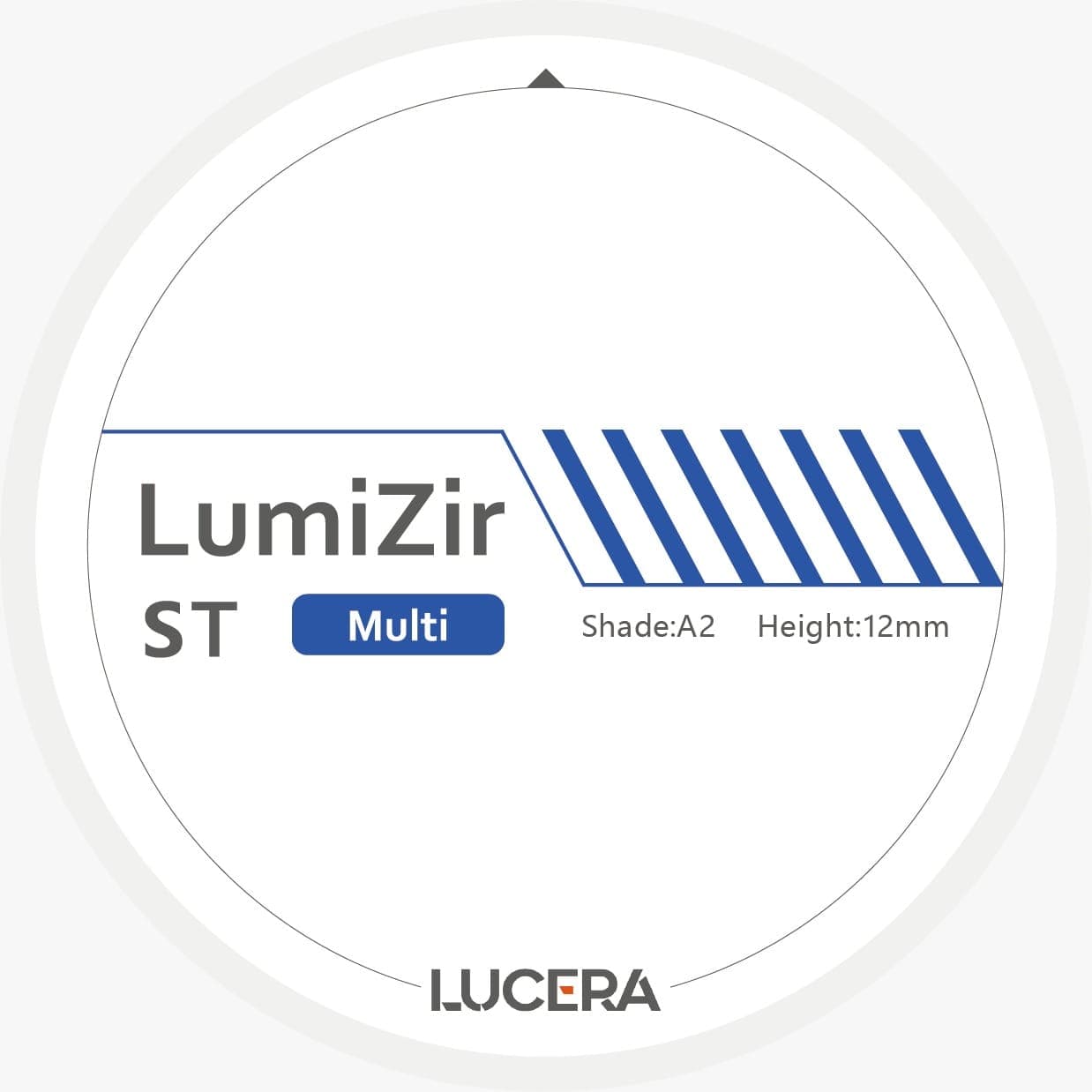
Photo : multilayer zirconia disc from the Dentev catalog.