A zirconia crown or bridge cracks during sintering most often from a combination of two causes: a temperature curve that does not respect the hold point and the rates set in the disc's instructions, and pieces poorly positioned in the furnace, touching each other, the tray, or a wall. In the green state, zirconia is brittle and tolerates internal stress poorly: heating too fast, cooling too abruptly, or a restoration still damp from coloring liquid all create microcracks that propagate, sometimes only after the restoration is seated in the mouth.
Does heating too fast crack zirconia?
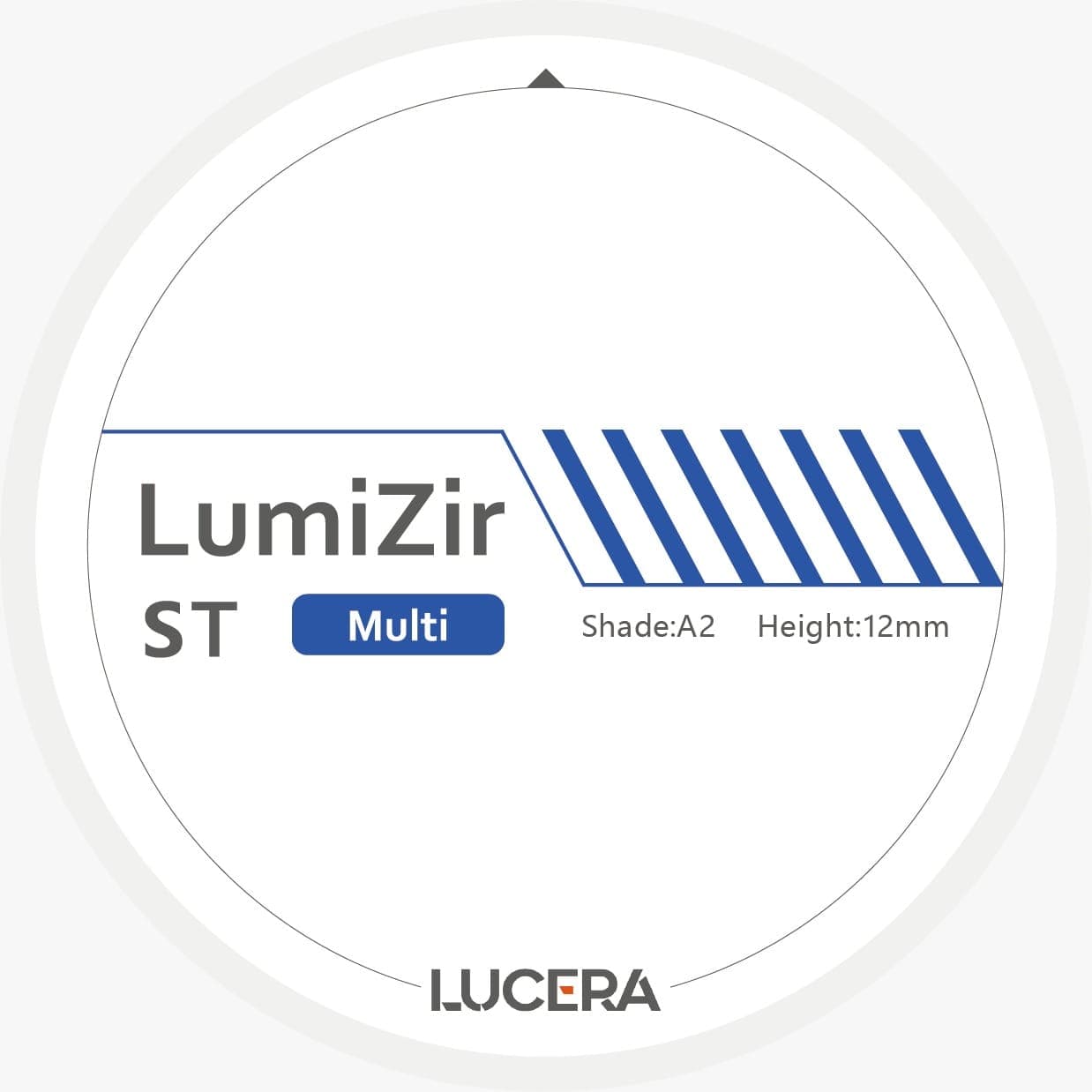
Yes. The instructions from the manufacturer of the zirconia discs distributed by Dentev warn that heating too fast "creates internal stress and microcracks", and set a heating rate of 3 to 8 °C per minute depending on the disc range, for a recommended hold of 1,530 °C on the ST and SHT ranges, 1,500 °C on the 3D Pro multilayer range, and 1,450 °C on the UT range, held for 120 minutes.
Kuraray Noritake, which manufactures KATANA zirconia, publishes a similar benchmark for its general sintering program: heating and cooling at 10 °C per minute, with a two hour hold at a temperature between 1,500 °C and 1,550 °C depending on the disc range. Its fast program, which brings the total cycle down to 90 minutes with heating of up to 35 °C per minute, is explicitly limited to bridges of up to three units: beyond that, the manufacturer requires the general program. That limit shows that the tolerable heating rate depends directly on the mass and geometry of the piece, not just the zirconia range.
What is the risk of a restoration that is still damp from coloring liquid?
A shade defect first, a crack afterward. The instructions from the manufacturer of the Dentev discs require the piece to be perfectly dry before it enters the furnace, after drying under an infrared lamp following coloring by dipping or brushing. Residual water that flashes off suddenly at the very start of the heating ramp adds extra stress to a piece already under load from sintering shrinkage, right when green zirconia is at its most fragile.
Often, yes. The Dentev instructions state it directly: "poor positioning on the sintering beads can deform the piece." A trade article published in September 2026 by LMT, a dental lab management magazine, details the role of already sintered zirconia beads as sintering support: according to that article, they provide multi-point support that lets shrinkage happen without restriction, which limits the risk of distortion in complex geometries such as multi-unit bridges. The same article credits low mass alumina trays with not cracking themselves during the cycle, unlike denser supports that absorb heat unevenly.
The Dentev instructions add that an overloaded furnace heats unevenly between pieces: two restorations placed too close together, or too dense a load, receive different amounts of thermal energy at the same moment, creating local shrinkage differences and stress at contact points.
Does cooling matter as much as heating?
Yes, and it is often watched less closely. The Dentev instructions set a cooling rate of 5 to 15 °C per minute, to be respected as strictly as the heating rate. Kuraray Noritake's general program for KATANA zirconia keeps a symmetrical 10 °C per minute on the way down, while its fast program, reserved for small pieces, goes down to 45 °C per minute: the tolerance margin for fast cooling also shrinks with the size of the restoration. Cooling too abruptly, or opening the furnace door before the displayed cycle ends, exposes the still hot piece to thermal shock that sintered zirconia absorbs poorly.
Does uneven thickness raise the risk of cracking?
Yes, because zirconia shrinks during sintering by a factor specific to each batch, between 1.220 and 1.260 according to the Dentev discs' instructions. A piece whose thickness varies sharply from one area to another, typical of the thin connectors in multi-unit bridges, shrinks unevenly within the same furnace cycle. A technical analysis published in May 2026 by zirconia manufacturer Yucera explicitly links post-sintering cracks to structural designs where connector zones that are too thin concentrate stress, and to inconsistent milling density that causes non-uniform shrinkage within the same piece.
What should be done about an overloaded or poorly calibrated furnace?
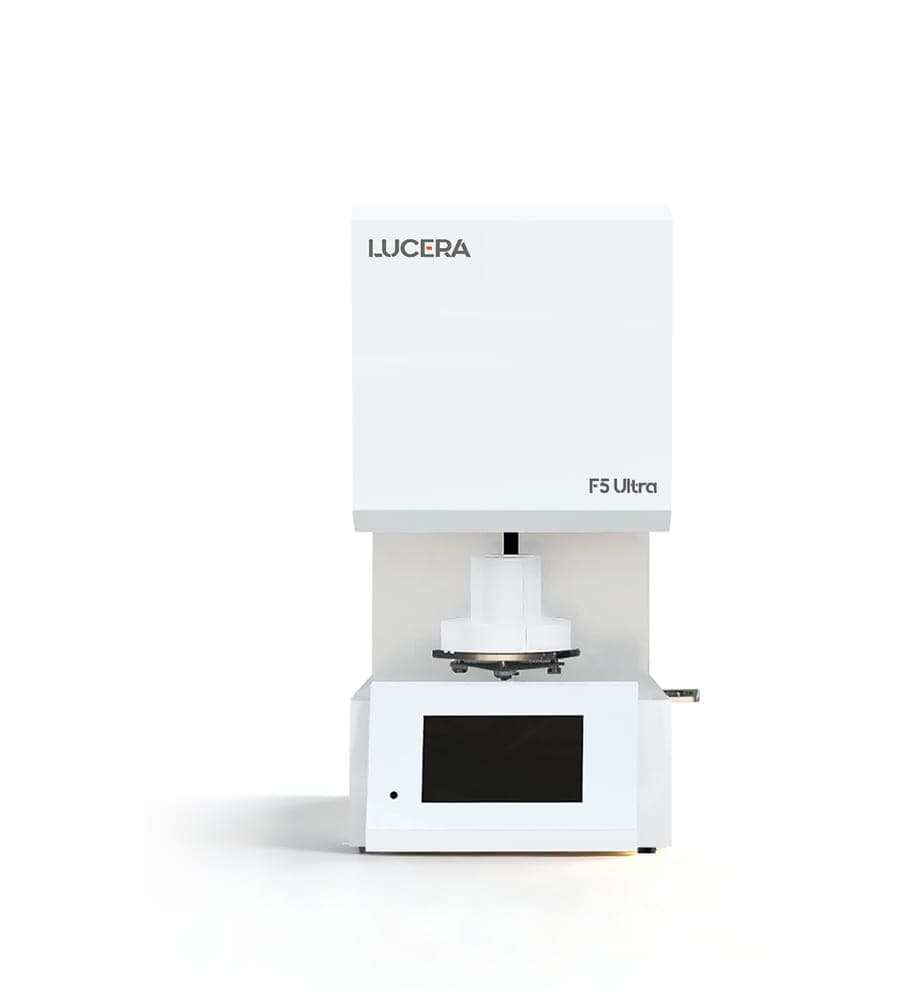
Keep the load reasonable and check the furnace regularly. The Dentev discs' instructions note that heating elements near the end of their service life cause the actual temperature to drift from the displayed temperature, and recommend periodic checks to avoid lost, or even cracked, batches without the gap being visible on the control screen. The Dentev catalog offers sintering furnaces with different maximum rates by model, as stated by their manufacturer, from 60 °C per minute to 250 °C per minute: a high maximum rate never excuses skipping the rate recommended by the instructions of the disc currently being sintered, which always remains the reference to follow.
- Recommended heating rate for ST, SHT, 3D Pro and UT discs: 3 to 8 °C per minute (instructions from the manufacturer of the discs distributed by Dentev)
- Recommended cooling rate: 5 to 15 °C per minute (instructions from the manufacturer of the discs distributed by Dentev)
- Hold time at the sintering temperature: 120 minutes (instructions from the manufacturer of the discs distributed by Dentev)
- Shrinkage factor of Dentev discs: 1.220 to 1.260, specific to each batch (instructions from the manufacturer of the discs distributed by Dentev)
- KATANA general sintering program: heating and cooling at 10 °C per minute, 2 hour hold between 1,500 and 1,550 °C (Kuraray Noritake, page checked October 2026)
- KATANA fast sintering program: 90 minute total cycle, limited to bridges of 3 units maximum (Kuraray Noritake, page checked October 2026)
- Causes of non-uniform shrinkage cited for post-sintering cracks: connectors that are too thin and inconsistent milling density (Yucera, technical analysis, May 4, 2026)
Sources
Instructions from the manufacturer of the zirconia discs distributed by Dentev, summarized in internal sintering documentation (CE marking, notified body 1639, EN ISO 6872 standard).
"Sintering Schedule", KATANA Zirconia, Kuraray Noritake Dental, kuraraynoritake.com, page checked October 2026.
"Why zirconia crowns crack after sintering: technical analysis for dental labs", Yucera, yucera.com, May 4, 2026.
"Sintering Trays & Zirconia Beads", LMT (Lab Management Today), lmtmag.com, September 2026.