According to the instructions for use of four manufacturers read for this article, a milled PMMA provisional crown needs a wall of at least 0.6 to 1 mm and an occlusal thickness of at least 1 to 1.5 mm, and a bridge needs a connector cross-section of at least 9 to 12 mm², up to 22 mm² from four units upward at Dental Direkt. These minimums are not interchangeable between brands: the instructions for the disc actually mounted on the milling machine take precedence. The time in the mouth stated by the manufacturers ranges from 12 months to 3 years.
- Minimum occlusal thickness: 1.5 mm (Dental Direkt, instructions of 29/02/2024); 1 mm (Dentsply Sirona, instructions of March 2021)
- Minimum wall: 0.6 mm cervical (Dentsply Sirona, March 2021); 0.8 mm (Dental Direkt, 29/02/2024); 1 mm (Harvest, instructions rev. 5; Merz, instructions of July 2018, after polishing)
- Connector of a three-unit bridge: 12 mm² (Dental Direkt, 29/02/2024; Harvest, rev. 5); 9 mm² (Merz, July 2018, one pontic)
- Connector of a bridge of four units or more: 22 mm² (Dental Direkt, 29/02/2024)
- Connector expressed as a diameter: 3.6 mm anterior, 4.4 mm posterior (Dentsply Sirona, March 2021)
- Stated time in the mouth: up to 12 months (Dental Direkt, 29/02/2024); up to 3 years (Merz, July 2018)
What minimum thickness for a milled PMMA provisional crown?
Between 0.6 and 1 mm of wall and between 1 and 1.5 mm occlusally, depending on the disc's instructions. The four manufacturers do not set the same threshold:
- Dental Direkt (DD provi P HI): wall of at least 0.8 mm and occlusal thickness of at least 1.5 mm (instructions rev. 02 of 29/02/2024);
- Dentsply Sirona: 1 mm occlusal and 0.6 mm cervical (instructions 331487 rev. 4, March 2021);
- Harvest (Temp Esthetic): wall of at least 1 mm for crowns (instructions FRM-IFU-09 rev. 5);
- Merz (M-PM Disc): wall of at least 1 mm after polishing (information of July 2018).
Merz specifies that its minimum applies after polishing: the design must therefore include the material that finishing will remove.
What connector cross-section for a provisional PMMA bridge?
From 9 to 12 mm² for a short bridge, and 22 mm² from four units upward at Dental Direkt, according to the instructions read:
- Dental Direkt: at least 12 mm² for a three-unit bridge, at least 22 mm² for four units or more; the instructions contraindicate bridges with two molar-sized pontics (instructions of 29/02/2024);
- Merz: at least 9 mm² with one pontic, at least 12 mm² up to two pontics (July 2018);
- Harvest: at least 12 mm² with one pontic and also up to two (instructions rev. 5);
- Dentsply Sirona: minimum diameter of 3.6 mm anterior and 4.4 mm posterior (March 2021).
Dentsply Sirona reasons in diameter, not in cross-section. As a rough guide, a circular connector of 3.6 mm is about 10 mm² and one of 4.4 mm about 15 mm² (our own calculation, not stated in the instructions). Real bridge connectors are rarely circular: measure the minimum cross-section on the designed part rather than deducing it from a diameter.
Why do the minimums differ from one set of instructions to another?
Because each manufacturer sets its limits on its own material, with its own tests, at its own date. The instructions read date from 2016, 2018, 2021 and 2024.
Dental Direkt classes its disc as a high-impact thermoplastic of type 3 according to ISO 20795-1:2013, and states two flexural strengths for the same disc depending on the test standard: 96 MPa in a three-point test following ISO 10477 and 65 MPa according to ISO 20795-1. Harvest states more than 100 MPa and Dentsply Sirona more than 80 MPa (instructions of 2016): without knowing the test standard, these manufacturer values cannot be compared.
Another gap lies in the contraindications. The Dentsply Sirona instructions of September 2016 listed any permanent restoration, bruxism or recalcitrant parafunctional habits, insufficient space, endodontic posts, endosseous implants and inlay bridges. The March 2021 instructions, devoted to multilayer discs, retain only hypersensitivity to methacrylate. Harvest, by contrast, lists implant-supported and abutment-supported prostheses among its intended uses.
When the instructions for the batch are missing, our own caution, not issued by any manufacturer, is to keep the highest values read here: 1.5 mm occlusal, 1 mm wall, 12 mm² for three units, 22 mm² beyond.
How long can a provisional PMMA restoration stay in the mouth?
According to the manufacturer's instructions: up to 12 months for Dental Direkt's DD provi P HI (instructions of 29/02/2024) and up to 3 years for Merz's M-PM Disc (information of July 2018).
Merz asks for the piece to be repaired or remade if fissures, cracks, clouding or marked wear appear, as checked at follow-up visits in the dental office. It is for the laboratory to state on the delivery note the duration given in the instructions of the disc used, so that the dentist can plan the follow-ups.
By avoiding heat build-up at every step: Merz and Dental Direkt both link heat to poor fit or to a surface that smears or melts.
- Milling: Dental Direkt requires single-edged tools or cooled wet milling, with a strategy suited to PMMA;
- Separating and finishing: cross-cut tungsten carbide burs or separating discs (Merz, Harvest, Dental Direkt); cut the connectors out carefully and without high pressure (Dental Direkt);
- Polishing: minimum pressure, otherwise the heat can smear or melt the surface (Dental Direkt);
- Cleaning: ultrasonic bath at 40 °C at most with a mild detergent; no steam blasting, no autoclave, no organic solvents or acids (acetone, hydrochloric acid), no highly concentrated alcohols (Dental Direkt); Dentsply Sirona allows UV sterilization only, without autoclave (instructions of 2016).
Where to place the piece in a multilayer PMMA disc?
Higher in the disc for more incisal, lower for less, according to the Dentsply Sirona instructions of March 2021. Tilting the piece within the disc also changes the shade gradient.
Which cement for a provisional PMMA restoration?
A temporary luting cement: all four sets of instructions provide for it. Dental Direkt lists temporary cements and glass ionomer cements; Merz lists temporary cements and glass ionomer cements without bonding; Harvest lists eugenol-free temporary cements; Dentsply Sirona notes that eugenol temporary cements may reduce the effectiveness of cementation (instructions of 2016).
What does the Dentev catalogue offer in PMMA?
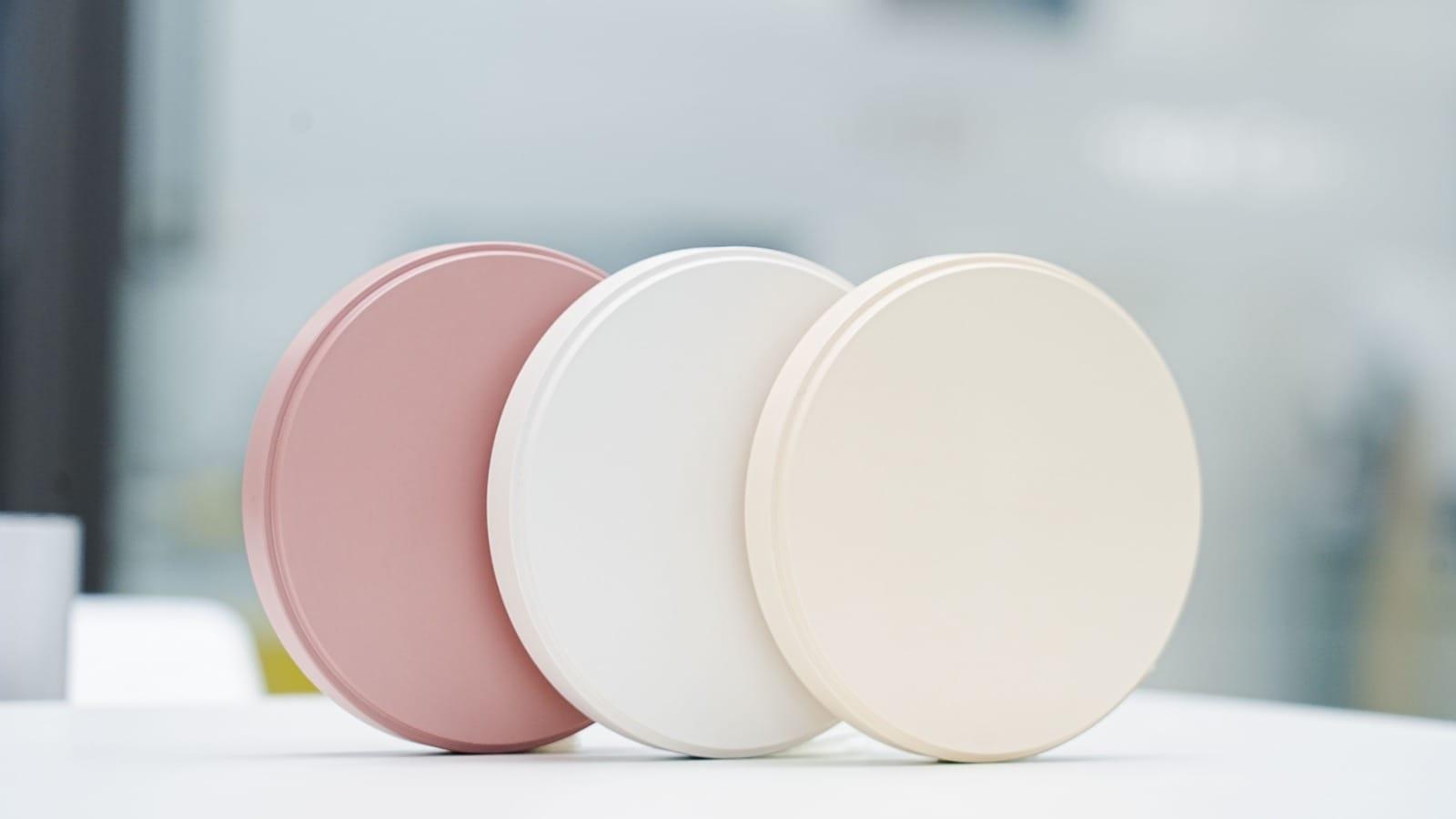
Dentev distributes single-layer and multilayer PMMA discs of Ø 98 mm, in thicknesses of 12 to 18 mm and 20 to 25 mm, described in the catalogue as compatible with exocad, 3Shape and DentalCAD, in VITA shades. Dentev is a supplier, not a manufacturer: for these discs, as for all others, the minimums to respect are those in the instructions of the manufacturer of the milled batch, not those of another brand quoted here.
Sources
Dental Direkt GmbH, "DD provi P HI, Gebrauchsanweisung / Instructions for use", Rev. 02, 29 February 2024: https://www.dentaldirekt.de/system/files/media/document/gebrauchsanweisung-instructions-for-use_dd-provi-p-hi_rev.02_20240229.pdf
Merz Dental GmbH, "M-PM Disc, PMMA milling blank, Instructions for use", information dated July 2018: https://cdn.shopify.com/s/files/1/0124/4918/5882/files/Merz_Dental_M-PM_Disc___instructions_of_use___valid_for_USA.pdf
Harvest Dental Products, LLC, "Harvest Temp Esthetic, Instructions for use", FRM-IFU-09 Rev. 5, no printed date: https://cdn.shopify.com/s/files/1/0267/0896/7467/files/FRM-IFU-09_Rev5_-_DFU_Temp_Esthetic3.pdf
Dentsply Sirona (DENTSPLY Prosthetics), "PMMA Disc, Directions for use", DP-0000176 Rev. 1, September 2016, copy distributed by Proclinic: https://www.proclinic.es/media/proclinic-es/annexes/h11623_h11624_h11643_ifu_es_en_de_fr_it.pdf
Dentsply Sirona, "Multilayer PMMA Discs, Instructions for use", 331487 Rev. 4, March 2021, copy distributed by med-dent24: https://www.med-dent24.com/Anleitungen/Multilayer_PMMA_20211201_INT.pdf
Dentev catalogue, single-layer and multilayer PMMA discs: https://www.dentev.com. All instructions were consulted on 27 November 2026. Photo: Dentev catalogue.