A crown or prosthesis printed in resin comes out of the printer in what is called a green state: it has neither its final mechanical properties nor its final biological properties. Two steps bring it to a usable state, washing in isopropyl alcohol and post-curing in a UV oven, and both have a precise duration that changes depending on the resin and the device. For the definitive crown resin Permanent Crown Resin by Formlabs, the instructions for use set a wash of 3 minutes maximum and a post-cure in two cycles of 20 minutes at 60°C. For an implant-supported hybrid denture resin such as SprintRay's OnX Tough 2, the washing protocol changes entirely. Getting it wrong in one direction leaves residual monomer and threatens biocompatibility; getting it wrong in the other damages dimensional accuracy and the part's strength.
How long to wash a printed crown in isopropyl alcohol
For Formlabs' Permanent Crown Resin, intended for definitive single crowns, inlays, onlays and veneers, the instructions for use dated 14 January 2025 set a wash of 3 minutes maximum in a Form Wash filled with isopropyl alcohol (IPA) at 99% minimum, with the parts fully submerged. The instructions specify that a longer wash affects the part's dimensional accuracy and performance over time: this is therefore not a cautious minimum to exceed for safety, but an upper limit not to be crossed. A brush and an IPA spray bottle can finish cleaning between supports without extending the bath itself.
For an implant-supported hybrid denture resin such as SprintRay's OnX Tough 2, the workflow guide dated 11 June 2024 offers two washing methods, to be chosen one or the other without combining them. By hand: a spray of 91% IPA and a wipe with a dry towel for 15 seconds, then air-drying with compressed air for 30 seconds, then another spray and wipe for 15 seconds. By machine, with a SprintRay Wash: a 3-minute wash cycle followed by 3 minutes of drying, with no second bath. The guide is explicit about the gap between the two methods: machine washing is more convenient, but it reduces the part's mechanical properties by up to 40% compared with handwashing, and should therefore be reserved for try-ins and short-term temporaries, never for a part meant to stay in the mouth for several months.
Why too long a bath in isopropyl alcohol damages the part
IPA dissolves uncured resin on the surface, but it also slightly penetrates the resin already set during printing. Beyond the time stated by the manufacturer, this momentary swelling ends up permanently deforming the part and weakening the polymer network even before post-curing. This is why both instructions for use cited give a maximum duration rather than a wide range: the risk is not leaving sticky resin on the surface, but indirectly removing part of the material itself.
What post-curing cycles apply depending on the device used
Once washed and dried, the part remains in the green state until it has gone through a full post-curing cycle. Formlabs' instructions for use dated 14 January 2025 distinguish three devices for Permanent Crown Resin, each with different cycles.
- Form Cure, first generation: two 20-minute cycles at 60°C, with the part flipped between the two (raft side down, then occlusal plane facing up), with sandblasting using 50-micrometre glass beads at a maximum of 1.5 bar between the two cycles to remove the white surface coating.
- Fast Cure: two 2.5-minute cycles at light intensity 1, with the same logic of flipping and sandblasting between the two passes.
- Form Cure second generation: a single 10-minute cycle at 60°C, occlusal plane facing up, since the device lights the part evenly enough to skip the second pass.
In all three cases, the instructions insist on one point: the two cycles are not a comfort precaution, they determine the crown's compliance and biocompatibility. Any deviation from this protocol can result in an unsatisfactory fit once the part is in the mouth, and the instructions call for discarding any cracked restoration rather than repairing it in the mouth.
And for an implant-supported hybrid denture resin
The SprintRay guide does not give a duration in minutes for post-curing OnX Tough 2: it points instead to a pre-programmed profile in the device, named "OnX Tough 2, Max Strength" on the NanoCure oven, or simply "OnX Tough 2" on the ProCure 2. This is the difference between resins designed for a generic oven, where the lab sets its own time and temperature, and resins designed for a closed ecosystem, where the resin-and-oven pairing is factory-calibrated. In this second case, good practice is to check that the exact material profile is selected before starting the cycle, rather than improvising a duration by analogy with another resin from the same manufacturer.
What is the risk with a poorly washed or poorly post-cured part
An incomplete wash leaves a film of liquid resin between the supports and on the internal surfaces, which then hardens unevenly and creates rough spots when the part is inserted. An incomplete post-cure is more serious: the resin remains partly in the green state, loaded with residual monomer, which Formlabs' instructions explicitly describe as a biocompatibility risk if the cycle is interrupted before completion; the part should then not be used until it has been cured for a full cycle. Conversely, too long an IPA bath or an oven cycle multiplied without reason does not make the part any safer: it degrades dimensional accuracy, and therefore clinical fit, with no biocompatibility gain in return.
What minimum thickness to respect from the design stage
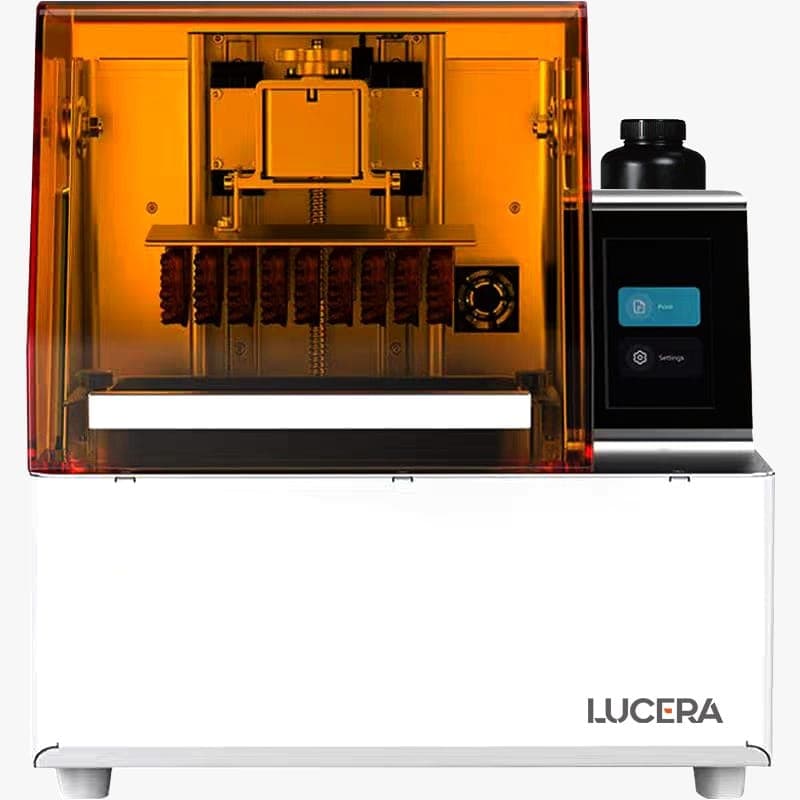
Post-processing does not fix a design flaw. For crowns, inlays and onlays in Permanent Crown Resin, Formlabs sets a minimum wall thickness of 1.0 mm in the anterior, posterior and cervical areas, and 0.5 mm for a veneer shell; the ratio between the crown height and the height of the abutment's bonding surface must not exceed 1.6. These values are set in the CAD software before printing, not afterwards. A lab equipped with a dental resin 3D printer, such as the one in Dentev's catalogue, follows the same washing and post-curing steps regardless of the resin brand chosen, but each manufacturer's instructions remain the reference to follow for exact durations.
- Washing Permanent Crown Resin (Formlabs): 3 minutes maximum, IPA 99% minimum (Formlabs instructions, 14/01/2025)
- Post-curing with Form Cure first generation: 2 cycles of 20 minutes at 60°C (Formlabs instructions, 14/01/2025)
- Post-curing with Form Cure second generation: 1 cycle of 10 minutes at 60°C (Formlabs instructions, 14/01/2025)
- Post-curing with Fast Cure: 2 cycles of 2.5 minutes at light intensity 1 (Formlabs instructions, 14/01/2025)
- Handwashing OnX Tough 2 (SprintRay): 91% IPA spray, 15 seconds, then compressed-air drying 30 seconds, then 15 seconds (SprintRay guide, 11/06/2024)
- Machine washing OnX Tough 2: 3 minutes plus 3 minutes of drying, up to 40% less mechanical strength than handwashing (SprintRay guide, 11/06/2024)
- Minimum wall thickness, Permanent Crown Resin: 1.0 mm (teeth, cervical), 0.5 mm (veneer) (Formlabs instructions, 14/01/2025)
- Sandblasting between post-cure cycles: 50-micrometre glass beads, maximum pressure 1.5 bar (Formlabs instructions, 14/01/2025)
Sources
Formlabs, "Permanent Crown Resin, Instructions for Use," prepared 14 January 2025, reference PRNT-106964, REF 20811/02 Rev 06, media.formlabs.com.
SprintRay, "Workflow guide: 3D printing for fixed hybrid dentures," effective date 11 June 2024, document distributed by astemdigital.fr.