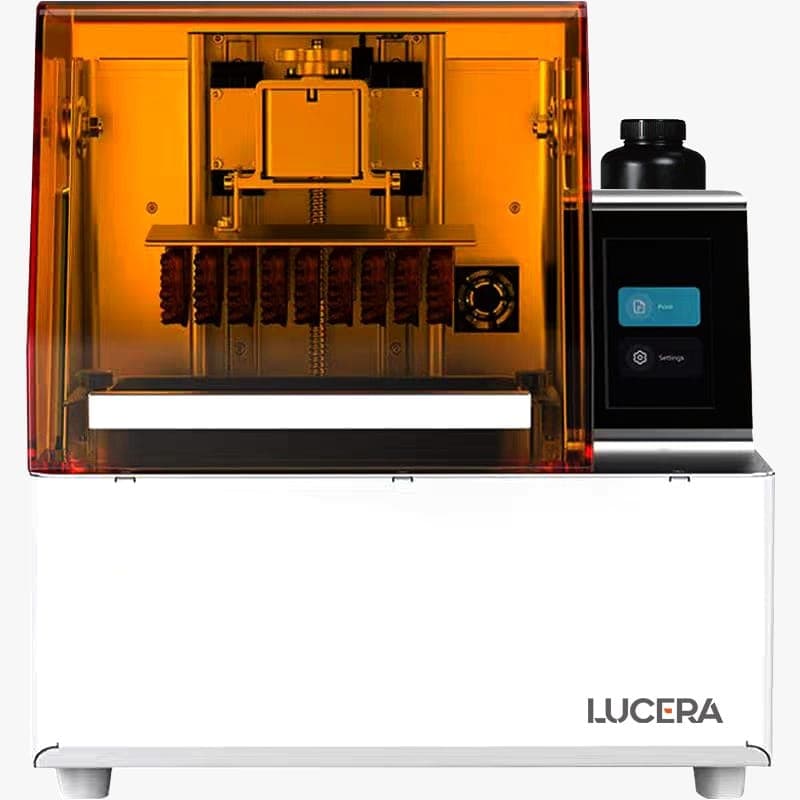
In most labs equipped with a resin 3D printer, the use case has stayed the same for years: working models, splints, surgical guides, provisionals. Definitive restorations remain the domain of milling: zirconia, lithium disilicate, sometimes reinforced PMMA. That line between printing and milling has just been tested by a product launch in the United States, one worth watching even though it hasn't reached the European or Latin American market yet.
A ceramic-filled resin, cleared for same-visit dentistry
American manufacturer SprintRay, known for its dental 3D printers, announced in early September 2026 the availability of Midas Restore, a new composite resin for definitive restorations: full crowns, inlays, onlays and veneers. The material received an FDA 510(k) Class II clearance, reference K260661, granted on April 15, 2026, based on substantial equivalence with products already on the market. Sales began on September 1, 2026, for now in the United States only: the product carries no CE mark and is therefore not legally available in France, Spain, Argentina or Chile as of today.
On the technical side, SprintRay states a glass-ceramic and zirconia filler content above 75% by weight, a flexural strength of 215 MPa measured under ISO 6872, hardness above 80 HV, and 98% gloss retention after 5,000 simulated abrasion cycles. The manufacturer claims wear resistance five times higher than its previous definitive material, Ceramic Crown, over 200,000 cycles, along with a translucency parameter of 13.5, within the range offered by lithium disilicate. Announced post-curing time is about four minutes.
One point worth noting: the material is designed for the manufacturer's proprietary printer, launched in 2024, for chairside use. The dental office prints and seats the definitive restoration during the same visit, with no provisional and no impression sent to a lab.
What independent studies say about definitive printed resins
These manufacturer figures deserve context from the scientific literature. A systematic review published in January 2025 in the journal Materials compared the mechanical properties of 3D-printed resins for definitive restorations against milled resins and conventional ceramics. Definitive printed resins showed flexural strength ranging from 83.5 to 249 MPa depending on the material tested, versus 109.5 to 237.3 MPa for reference milled resins, and 299.3 MPa for the lithium disilicate (IPS e.max) cited in the study. The 215 MPa claimed for Midas Restore sits at the high end of the printed-resin range, but still below a milled glass ceramic.
The review's authors also flag the practical limits on any printed resin intended for a permanent restoration: polymerization shrinkage, sensitivity to the post-processing protocol, and printer calibration. Three factors that directly affect the final strength of the piece, and that don't depend on the material alone as listed on a spec sheet.
What changes, and what doesn't yet, for a lab
For a CAD/CAM-equipped prosthetics lab, this launch isn't an immediate tooling change. First, because the product explicitly targets the dental office in a chairside setup, not the lab: it's the practitioner who prints and seats the restoration the same day, bypassing an outsourced workflow. Second, because the reference for an aesthetic definitive restoration in milled zirconia or lithium disilicate remains, at this stage, better documented and more widely available: a lithium disilicate glass-ceramic block for crystallization, for example, already covers crown, veneer and inlay indications with a substantial clinical track record.
A lab's resin 3D printer today serves mainly to quickly produce working models, splints, surgical guides and provisionals, not definitive crowns. Switching use means a different material, a different post-curing protocol, and for now, outside the United States, a clearance that doesn't yet exist.
An FDA clearance doesn't equal European approval. Placing a medical device on the EU market requires a separate CE mark, issued after a conformity assessment under the European Medical Device Regulation, the MDR. That's why a material already cleared in the United States, like Midas Restore, can take several months, even years, to legally reach the French, Spanish, Argentine or Chilean market, assuming its manufacturer actually pursues that process.
That timeline gives labs room to watch and wait. It doesn't excuse ignoring the topic: cases where turnaround time trumps everything, an urgent replacement, a walk-in patient, a simple single unit, are precisely where an equipped dental office might eventually be tempted to skip the lab. Multi-unit bridges, high aesthetic-demand cases and large rehabilitations, by contrast, remain, based on data available today, out of reach for a chairside-printed resin: that's where the expertise of a lab equipped for zirconia and disilicate milling keeps its full value.
What this launch does confirm is a broader trend: resin manufacturers are investing in permanent restorations, a segment so far reserved for milling. A CE mark and an expansion beyond the US market, if they come, will be worth watching closely, especially for indications where turnaround time matters as much as high-precision aesthetics.
Sources
- TCT Magazine, "SprintRay launches FDA-cleared ceramic and zirconia-filled definitive restorative resin for patent-pending SLA process", published September 2, 2026, accessed September 18, 2026: tctmagazine.com
- U.S. Food and Drug Administration, 510(k) Premarket Notification database, submission K260661, decision date April 15, 2026, accessed September 18, 2026: accessdata.fda.gov
- "Flexural Strength, Fatigue Behavior, and Microhardness of Three-Dimensional (3D)-Printed Resin Material for Indirect Restorations: A Systematic Review", Materials journal, published January 2025, accessed September 18, 2026: pmc.ncbi.nlm.nih.gov/articles/PMC11818428/