A zirconia crown or bridge that comes loose a few months after cementation is almost never a material defect. More often, it is the trace of an incomplete bonding protocol. Zirconia behaves very differently from a glass ceramic such as lithium disilicate, and a laboratory that treats it the same way takes a risk it only sees when the case comes back.
Why zirconia resists classic bonding
Silane, the coupling agent that works so well on silica-rich ceramics such as disilicate or feldspathic ceramic, has almost no effect on zirconia. Zirconia is a polycrystalline ceramic with no glassy phase: it contains no silica for silane to bond to chemically. Bonding a zirconia piece exactly as one bonds a disilicate veneer therefore leads to a silent failure. The restoration holds at the time of cementation, then debonds months later under repeated chewing forces.
A review published on 5 October 2024 in the scientific journal Cureus notes that reliable bonding to zirconia depends on combining two distinct, complementary mechanisms: micromechanical retention obtained through surface treatment, and chemical adhesion obtained through an agent able to react with the zirconium oxide itself.
Alumina sandblasting: useful, but only in the right dose
The reference surface treatment remains sandblasting with 50-micron alumina (Al2O3) particles on the fitting surface of the piece. This blasting creates micromechanical roughness that increases the contact area available for the cement and improves the mechanical anchorage of the restoration.
The same review warns of a real risk: sandblasting that is too aggressive, in pressure or duration, can create microcracks in the zirconia that weaken the piece instead of properly preparing it. The step must stay controlled and limited to the bonding area only, without spreading to the rest of the framework. Newer methods, such as tribochemical silica coating or selective infiltration etching, give more stable long-term results but remain less common in the laboratory than classic alumina sandblasting.
MDP primer: the chemical bond silane cannot provide
Real chemical adhesion to zirconia requires an agent containing MDP, 10-methacryloyloxydecyl dihydrogen phosphate. This monomer forms stable phosphate-oxygen-zirconium bonds with the surface of the piece, a reaction silane alone cannot produce. The Cureus review states that applying the MDP primer twice, with enough contact time before assembly, gives better results than a single, rushed application.
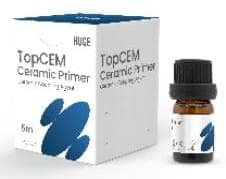
Some systems now combine several coupling agents in a single formula, MDP for zirconia and silane for silica-based ceramics, which simplifies the protocol for a laboratory working with several materials on the same day. The ceramic primer in Dentev's catalogue is used at this stage of chemical surface preparation, before assembly.
Cement choice matters as much as the primer
The technical documentation from adhesive systems manufacturer Kuraray Noritake, for its self-adhesive cement Panavia SA Cement Universal, illustrates this two-monomer approach well: a formula combining MDP, active on zirconia, metal and dentin, with a silane monomer called LCSi, active on silica-based ceramics, in a single dual-cure paste, light-cured for two to five seconds or left to self-cure for two to four minutes. The manufacturer presents this combination as a way to bond to several materials without switching primers between cases.
In the literature reviewed, resin cements remain preferred over conventional cements such as glass ionomer or zinc phosphate for demanding retention cases: long-span bridges, short abutments, preparations with limited retention. Compatibility between the primer used and the cement chosen should be checked before mixing systems from different brands: some are only validated together.
The three-step protocol, from sandblasting to seating
The combination recommended by the Cureus review fits into a simple acronym for the laboratory, APC: airborne particle abrasion, primer, cement.
- Sandblast the fitting surface with 50-micron alumina, at moderate pressure limited to the bonding area, then carefully remove all residual dust
- Apply the MDP primer in two successive coats, respecting the contact time stated by the manufacturer before assembly
- Seat the chosen resin cement under rubber dam isolation, then light-cure for about 40 seconds per accessible surface
Skipping a step, or shortening the primer's contact time to save a few minutes on a rushed case, remains the most frequent cause of debonding seen in the clinic.
What a laboratory gains from this
A bonding protocol followed from start to finish changes nothing in the design or milling of the piece. What it does change is the laboratory's reputation with the practice that seats the restoration: fewer returns for debonding, fewer urgent remakes, and a relationship of trust built over time rather than on the price of a single order.
Sources
- "A Comprehensive Review of Techniques for Enhancing Zirconia Bond Strength: Current Approaches and Emerging Innovations", Cureus journal, published 5 October 2024, accessed 15 September 2026: pmc.ncbi.nlm.nih.gov/articles/PMC11534439/
- Kuraray Noritake, Panavia SA Cement Universal product page, accessed 15 September 2026: kuraraydental.com/product/panavia-sa-cement-universal/